




Mother Ann Lee and Her Relics at Canterbury Shaker Village
Images of objects and written excerpts taken from Canterbury Shaker Village’s 2024 Exhibition “Keeping Faith: 250 Years of Shakerism in America.”
She was referred to as “Ann the Word,” but it was Ann Lee’s charisma and convictions that instilled confidence in her tiny society of religious supporters.
Born into a working-class family in Manchester, England, in 1736, Lee joined the “Shaking Quakers” in 1758 when she was 22 years old. After a life-altering spiritual revelation in 1770, Lee became the leader of the Shakers. Facing increased pressure from English authorities, Ann Lee and her closest followers left for the British colony of New York, arriving on August 6, 1774.
They arrived a mere month before the First Continental Congress met to decide how to respond to England’s “intolerable” laws. Shakerism and the new nation grew together.
In the last ten years of her life, Ann Lee spread the Shaker Testimony through Eastern New York and Southern New England. These years of religious persecution and physical attacks shortened Lee’s Life. She died on September 8, 1784. Her fearless efforts laid the groundwork for the establishment of Shaker Villages in New York, New Hampshire, Maine, Massachusetts, and Connecticut.
The Shakers kept and gave to each other objects related to Shakerism’s founding generation. The Shakers considered these objects as historical, reflecting their simple, democratic, and communal beliefs while acknowledging the objects’ importance for telling the Shakers’ story. Such objects are not necessarily rare. But they are precious for the memories they hold. Through such gifts the Sisters and Brethren learned from older generations and taught younger generations the admirable traits of leaders like Mother Ann Lee, or recounted events of triumph over adversity.
The Canterbury Shakers did not venerate relics in worship. No special place in the Meeting House is dedicated to their display or storage. Like family heirlooms and keepsakes, these objects were handed down through time from one person to another. For the communal Shakers of Canterbury, such objects helped to keep the faith of what was, in the nineteenth century, a relatively new and emerging religious sect.
As such, there are a handful of objects at Canterbury Shaker Village that can be tied to Mother Ann Lee.
Mother Ann Lee Dress
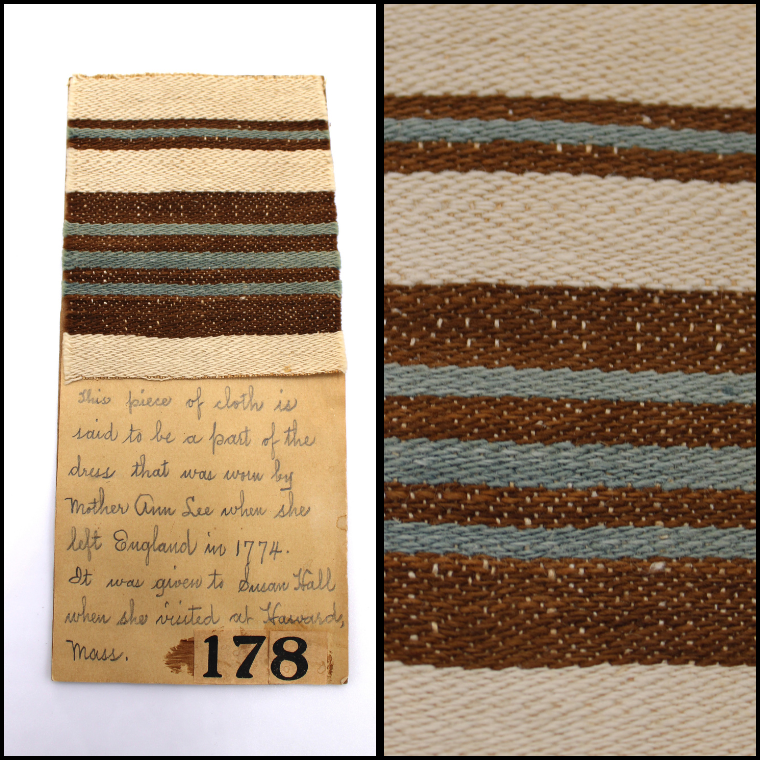
A piece of cloth we have in the collection is said to be a part of the dress that was worn by Mother Ann Lee when she left England in 1774. It was given to Susan Hall when she visited Harvard, Massachusetts.
This piece of handwoven cloth is a linen-cotton-jute twill blend. At Mother Ann Lee’s departure to the American colonies in 1774, clothing made of this textile was commonly worn by the working classes. Horizontal stripes were popular.
We do not know why or when Canterbury Sister Susan C. Hall (1834-1911) visited the Harvard Shaker Community. We do know that Mother Ann Lee lived in Harvard during her 1781-1783 missionary journey.
Hitching Ring and Tree
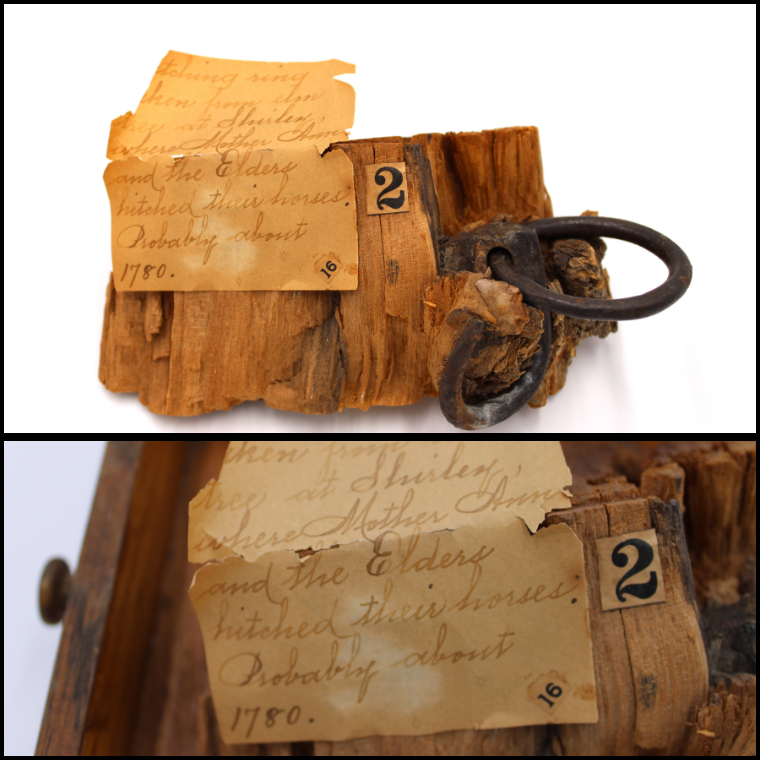
According to Shaker tradition, Mother Ann Lee, her brother William Lee, and James Whittaker hitched their horses to an elm tree in Elijah Wilds’ dooryard in Shirley, Massachusetts, between 1781 and 1783. Wilds’ farmstead became the site of the Shirley Shaker Community in 1793.
The hitching ring was taken from the elm tree at Shirley, where Mother Ann Lee and the Elders hitched their horses, probably about 1780. When this Community closed in 1908, the Shakers salvaged parts of this elm tree.
About Canterbury Shaker Village
Canterbury Shaker Village is a nonprofit-owned National Historic Landmark district featuring 25 restored Shaker buildings in their historic setting of 694 acres of forests, fields, gardens, and mill ponds. In addition to museum tours, exhibits, and programs, the preserved Shaker village provides a beautiful, relaxing, and inspiring environment for recreation, learning, reflection, and renewal of the human spirit.
Canterbury Shaker Village is a member of the NH Heritage Museum Trail, which connects the public with culturally rich heritage institutions in New Hampshire. For more information about The Trail, visit nhmuseumtrail.org.