Since the first of June, the sounds of hammers, planes, and human “hmmms” have consistently filled the air around the Canterbury Shakers’ “Ancient Church”—the Meeting House. Within its fenced yard are tools, the shapes and purposes of which have not changed for centuries (though some have been thoroughly modernized). Visitors, often in silence, watch and point at the building as its wood clapboards are removed and its frame is carefully lifted from its granite foundation.
Perhaps this contemporary scene of preservation and witness echoes the activities in the building’s construction in 1792. “A special regard was paid to the order of the work,” Shaker documents reveal, “and it is recorded that scarcely a word was spoken during the framing and raising of the building, except in a whisper.” Quiet the Shakers may have been, but the cacophony of that work was likely a welcome din, assuring their work in establishing their community of faith.
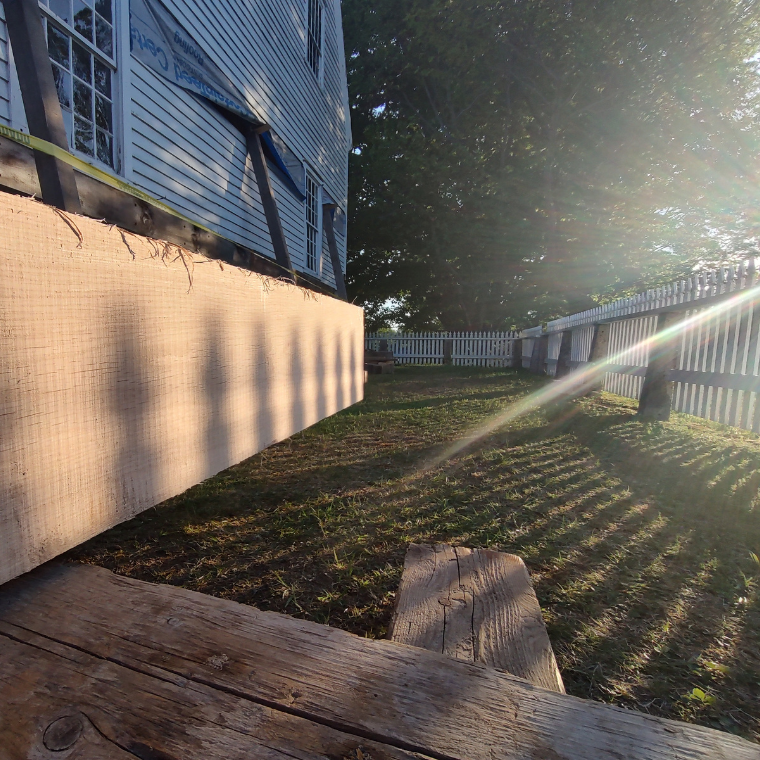
Timber, cut from Canterbury area, being prepared for sill replacement, north side of the Meeting House.
Constructing a faith requires community. Constructing a building requires wood, metal, glass, plaster, and paint. In 1791, Joseph Brackett, Sr. (whose son of the same name wrote “Simple Gifts”) visited the Shakers in Canterbury when they all lived in Benjamin Whitcher’s farmhouse. There he found the Brethren “cutting wood & timber” for “the people of Canterbury were making preparations to build a Meeting House.” Brother Joseph, “being an expert with the broad ax, hewed all the time he was in the place.” One look at the large timbers currently resting on sawhorses next to the building explains how much physical labor was needed. Strength of religious conviction, it seems, was matched by the physical strength of the individuals who hewed, sawed, dragged, shaped, and raised these beams into place.
Now, some 234 years later, the preservation carpenters are carefully disassembling parts of the Meeting House to ensure its future. Peeling back this building’s layers provides new knowledge crucial to its care and reveals what the Shakers knew and employed in its construction. For example, they found flashing covered by layers of birch bark—the eighteenth-century version of Tyvek—that provided protection against water and air.
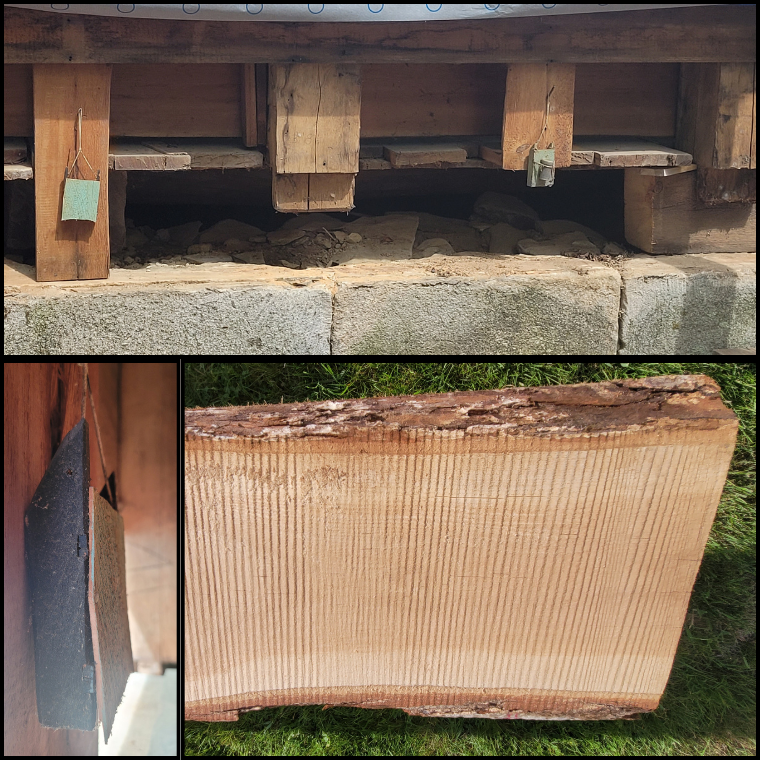
Other discoveries reveal activities beyond the building’s construction. Between the east wall’s clapboards and the Meeting Room’s wainscoting the carpenters found two miniature wood sleds, each hanging by a thick piece of string to a pie-cut iron nail hammered into a wood plank. Each sled’s runners carry black paint; each sled bed is painted in a pale blue hue. Penciled letters and the date “May 8, 1878” appear on each bed’s underside. One sled “carries” a soldered and capped metal cylinder.
Top: Two minuature sleds found on the east side of Meeting House; Bottom Left: Close Up of sled; Bottom Right: Profile of board prepared for sill.
Though these artifacts require much more research, the date and the fact that the pale blue paint layers on the sleds and the Meeting Room’s wainscoting match lead us to another layer in this story. In May 1878, the Canterbury Shakers were busy remodeling this space. They hired “Kneeland Codman, who chanced to call this way is employed to paint the wood work in the interior of the ‘Ancient Church.”
The wall seats have been removed walls lime-washed & wood-work painted a much paler shade of blue than formerly, window sashes re-painted settees revarnish[ed.] The Porch on the East side shared the same renovation[.]
This was the first time the interior had been renewed since the house was builded[.] A period of 86 yrs!
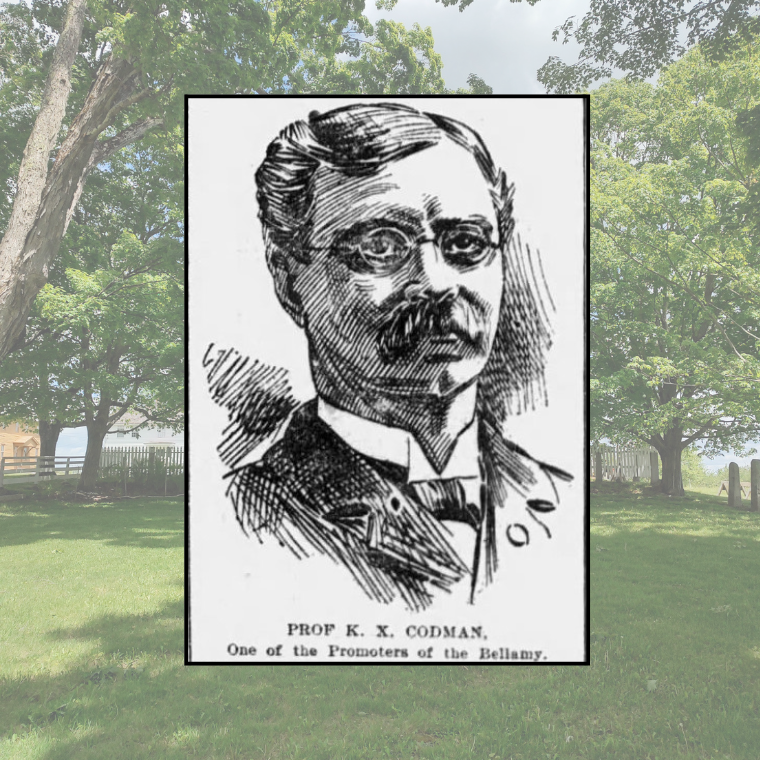
Kneeland X. Codman (1849-1899) had some acquaintance with the Shakers. He would return the Village in 1880 and “board awhile” at the Trustees’ Office, where he was painting the building’s dining rooms.
Inset Photo: Kneeland X. Codman; Background: Meeting House lawn.
When Codman painted the Meeting Room’s wainscoting, he needed to mix by hand the pigment, linseed oil, and mineral spirits. Codman’s occupation was “house painter” in the 1870 Federal Census but, in the 1890s, Nashua city directories listed him as a “color mixer.” At his death, newspapers noted that he had lived “in the Shaker community at Canterbury for a few years” before spending some time learning botanical pharmaceuticals at the Tilden Laboratory in New Lebanon, New York (near another Shaker community). Codman’s knowledge of chemistry won him the honorific title of “professor,” and he was part of the large contingent of scientists and businessmen who produced the first generation of commercially available, ready-mixed paints we today use.
What was Kneeland X. Codman thinking as he lay down the light blue paint on the Meeting House’s interior? With whom did he chat as he prepared the paint, cleaned his brushes, ate a noontime meal? What we do know is that Kneeland X. Codman, at the end of his life, was involved in creating a Bellamy colony in Massachusetts. According to an 1899 newspaper interview, he had studied many communal movements beyond the knowledge he gained of and with the Shakers. Inspired by Edward Bellamy’s best-selling 1888 novel Looking Backward, he joined in a nationwide effort to realize utopia. Codman, paint brush in hand, began his work for a perfect society at the Canterbury Shakers’ Meeting House.