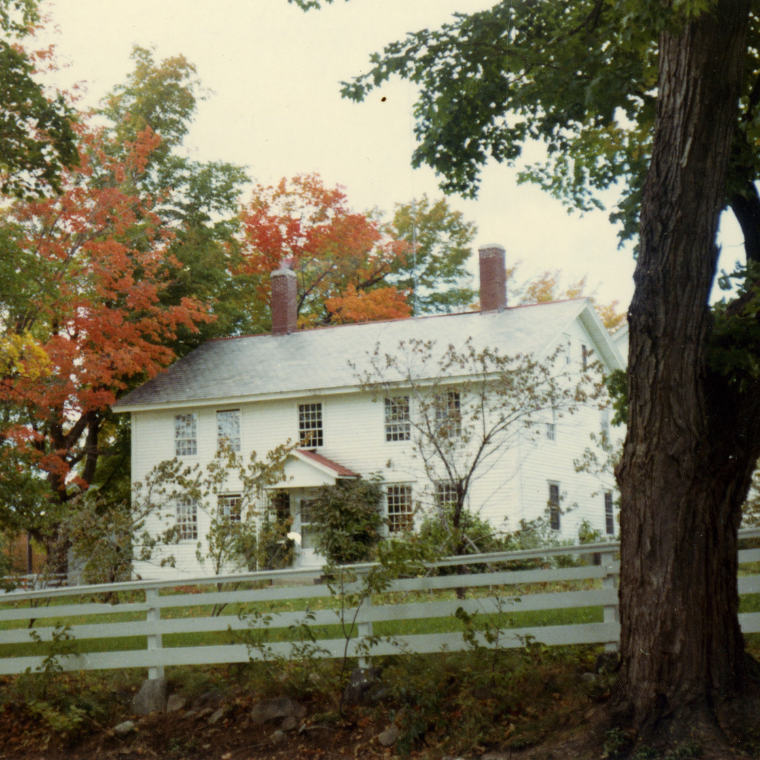
Canterbury’s Infirmary: A Shaker Legacy of Care and Discovery
Canterbury's Infirmary: A Shaker Legacy of Care and Discovery
Expert medical practice.
Scientific discovery.
Community care.
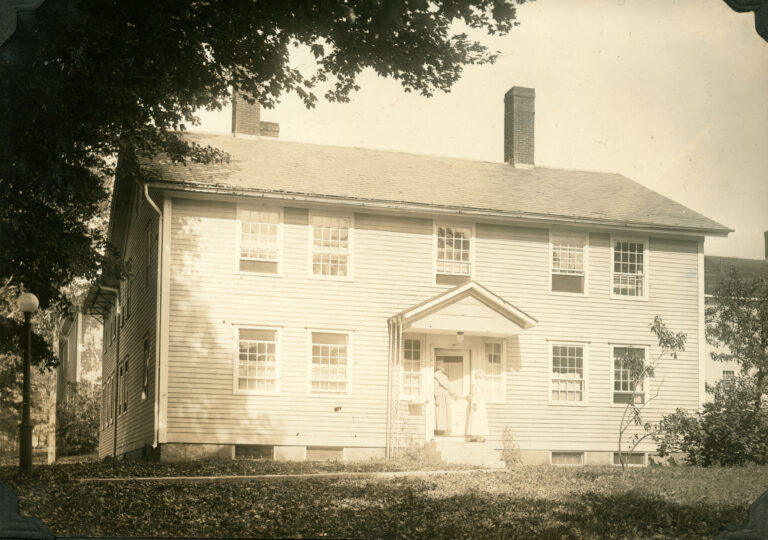
For the Shakers of Canterbury, all these activities were centered in their community’s Infirmary. This wood frame building—one of the earliest in the Village—was constructed in 1811 to house the Church Family trustees and visitors. Located next to Shaker Road, the building marked the boundary between the Village and the World, while providing a space for business transactions and social interactions between the Shakers and the World’s People (the term used by Shakers to designate non-Shakers).
In 1849, the Shakers repurposed the building as an infirmary. In an era when physicians visited patients in their homes and hospitals were for the sick poor and aged, the Shakers created a novel—indeed, progressive—health-care space. Within the Infirmary’s walls were a pharmacy, an office, patient rooms, and a kitchen.
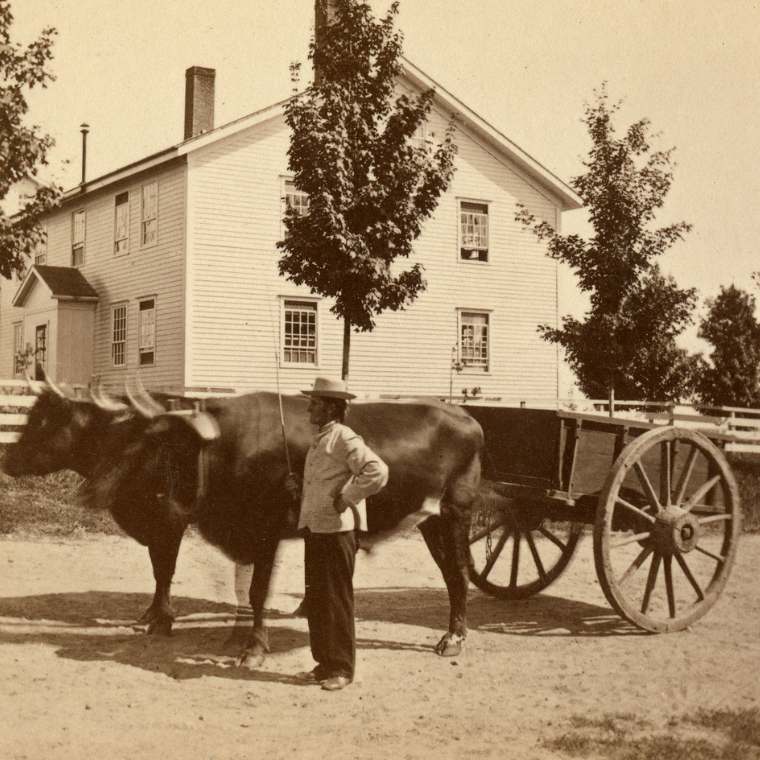
Before north wing added, Brother Daniel Perkins and The Infirmary, 1880.
In its history of use as an infirmary well into the 1930s, we find the story of the Shakers’ embrace of medical advances. The community’s first water closet was installed in 1852 and modernized in 1886. This form of plumbing ensured a more sanitary environment before germ theory guided medical principles and practices. In 1892, a wing was added on the building’s north side. Sanitary features, including metal beds, running water in the patients’ rooms, and a full bathroom, were also added in this year. This two-and-a-half-story, 5,515-square-foot, “L” shaped building was continually outfitted for the best in medical care.
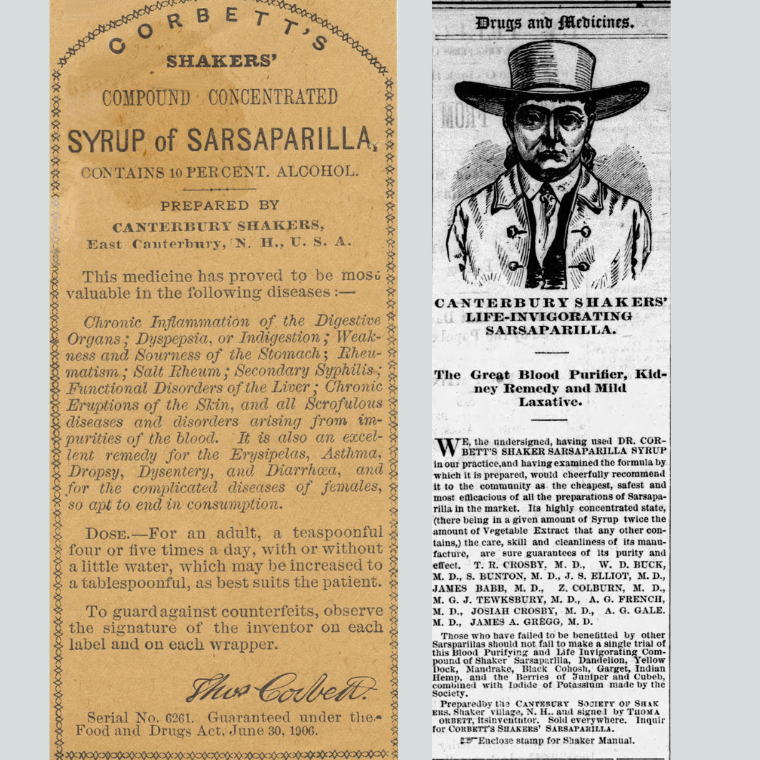
The Canterbury Shakers were widely known proponents of holistic medicine, and physicians and others visited them to learn about their reformist practices of health and medicine. In the 1790s, the Canterbury Shakers began and maintained a relationship with Dartmouth’s then-new medical school. In 1813, the Canterbury Shakers chose Brother Thomas Corbett (1780-1857) to train as a physician. Corbett then developed and managed the community’s popular medicinal herbal business that grew to serve the Northeast by the mid-nineteenth century. His medical inventions, such as an “electric generator,” sought to soothe the stiff and sore muscles caused by the physical labor in the community’s fields, gardens, mills, shops, and kitchens.
Various Newspaper Ads for Dr. Corbett's Syrup of Sarsaparilla
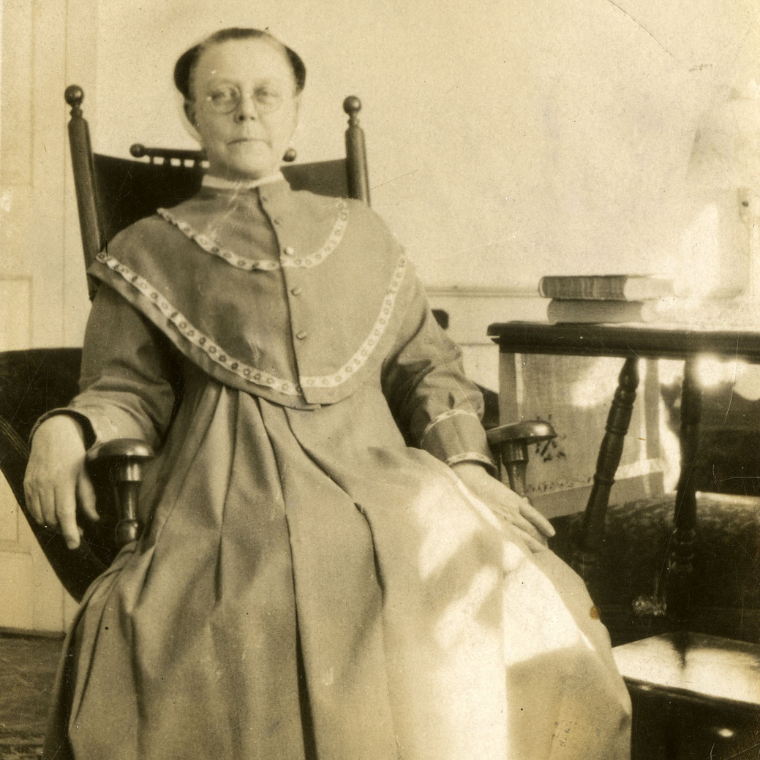
Shaker sisters were integral to the community’s medical care, so much so that the Infirmary was also called the “Nurses’ Shop.” For much of the nineteenth century, the sisters themselves (and Federal Census takers) recorded their occupation as “phisioness” (a woman physician). So important was their knowledge and practice that early feminists, such as Swedish reformer Fredrika Bremer (1801-1865) and Harriott Keziah Hunt (1805-1875), the first woman admitted to Harvard Medical School, visited the Canterbury Shakers to investigate their medical practices. They also remarked on the overall better health of the Shaker sisters.
Shaker historian Scott T. Swank observes, “With a progressive approach to community health care, supported by modern facilities and equipment, the Canterbury Shakers could provide medical care superior to that available to the average New Englander.” The Infirmary today represents not only the improvements in medical science but also in compassionate care. Many of the World’s People sought medical treatment at the Infirmary. The building’s proximity to the road facilitated these interactions. The Shakers’ willingness to extend their ideas of care and comfort into practice with non-Shakers symbolizes their larger philosophy of care and humane worldview.
Sister Jessie Evans, Shaker nurse in the early 20th Century
The Infirmary is a rare surviving example of a Shaker hospital and is the only one currently accessible to the public. Historic infirmaries are uncommon: the National Register of Historic Places (NRHP) individually lists only 33 buildings as “infirmaries,” with none in New Hampshire. There are two NRHP sites designated as “hospitals” in New Hampshire; however, the Infirmary’s medical use pre-dates both. The Infirmary is also the only historic pharmacy on exhibition in New Hampshire, according to the American Institute of the History of Pharmacy.
Canterbury Shaker Village’s Infirmary is a fascinating legacy of the Shakers’ relationship with the science of medicine and the communal practice of care, for Shakers and non-Shakers alike. Today, the public may tour the building’s first and second floors, where they will find in each room exhibitions on the Canterbury Shakers’ duty of care through medicine, technology, and comfort.
Canterbury Shaker Village is a nonprofit-owned National Historic Landmark district featuring 25 restored Shaker buildings in their historic setting of 694 acres of forests, fields, gardens, and mill ponds. In addition to museum tours, exhibits, and programs, the preserved Shaker village provides a beautiful, relaxing, and inspiring environment for recreation, learning, reflection, and renewal of the human spirit.
Canterbury Shaker Village is a member of the NH Heritage Museum Trail, which connects the public with culturally rich heritage institutions in New Hampshire. For more information about The Trail, visit nhmuseumtrail.org.