




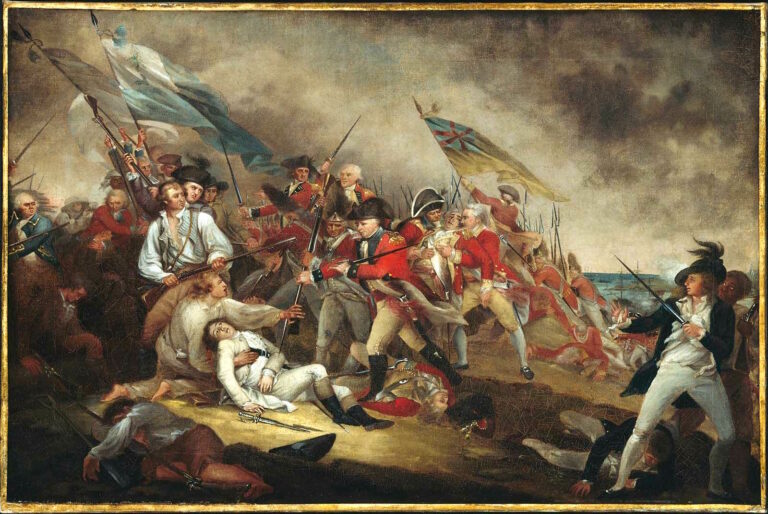
On the morning of June 17, 1775, British forces in Boston, Massachusetts launched a full-frontal assault on fortified American positions across the Charles River on Breed’s and Bunker Hills. After three separate and costly attacks, British forces were able to take the American positions and with it control of Boston Harbor. Despite being a British military victory, the assault was a costly one. The British suffered twice the number of casualties as the Americans.
The American soldiers who fought at the Battle of Bunker Hill came from many different backgrounds and classes of colonial American society. This demographic reality would be reflected in both the future Continental Army and the many state militias for the duration of the Revolutionary War. Among the enlisted men who served at this battle were several who would in the future call Canterbury Shaker Village home. One of these was John Wadleigh.
John Wadleigh was born on March 1,1759 in Hampstead, New Hampshire. His father, Thomas, was an influential man and proprietor of the town of Sutton, New Hampshire. In 1775, Wadleigh enlisted in the 3rd New Hampshire Regiment led by Colonel James Reed. At the Battle of Bunker Hill, Wadleigh’s regiment, along with John Stark’s 1st New Hampshire regiment was stationed on the Americans’ left flank.
After the Battle of Bunker Hill, Wadleigh continued to serve the American cause, reenlisting for several more campaigns. According to an 1848 interview in The Farmer’s Monthly Visitor, in addition to Bunker Hill, Wadleigh also served at the battles of Fort Ticonderoga, Saratoga, Rhode Island, and Yorktown.[i] Wadleigh’s military service can be traced in two New Hampshire muster roll records in the National Archives. These historic records show a discrepancy in Wadleigh’s discharge date: one muster roll records the date as January 3, 1779, while the other lists him serving at various military camps in 1780.[ii][iii] One possible explanation for this discrepancy is the fact that Wadleigh’s last name was also spelled as Wadley.
After his military service, John Wadleigh converted to Shakerism and moved to Enfield, New Hampshire where a small group of Shakers were unofficially gathered. During this period, he also visited Ann Lee and the Elders at Ashfield, Massachusetts. In 1792, Wadleigh moved to Canterbury and quickly became an integral member of the newly formed community. For a brief period from 1794 to 1795, he was an assistant elder for the Church Family. A year later, his name appears in the original 1796 Canterbury Church Family Covenant.
After leaving the Order of Elders, Wadleigh became the manager of the Church Family farm, a position he held for over twenty years. When Wadleigh was interviewed by former New Hampshire Governor Isaac Hill in the 1840s, he was, in his mid-eighties, still tending the Community’s fields. Hill was especially interested in Wadleigh’s military service and refusal to accept his military pension based on the Shaker belief in pacifism.
He [Wadleigh] had served long enough in the army of the revolution to be entitled to a full pension; but he had never applied for it because he had enough for his support-he said he brought nothing into the world, and he rejoiced that he wanted nothing, to carry out of it. He had enjoyed for a long time that peace which the world could neither give nor take away.[iv]
Interestingly though, in August 1852 Wadleigh “in consequence of his great age and infirmity” was represented in probate court by a solicitor of claims Zebulon K. Harmon who submitted a pension affidavit along with supporting documentation on his behalf.[v] It is possible that application was not widely known among the Canterbury Shakers because Henry Blinn in the Shaker Manifesto in August 1883 described how “[Wadleigh] becoming a member of the Shaker community soon after the close of the war, he never applied for, nor received the pension to which he was entitled by the laws of his country.[vi] The motivation for this change of heart and the circumstances surrounding this affidavit deserves further research.
After a lifetime of service, John Wadleigh died on October 23, 1852 at the age of 93, a dedicated member of the Community until the end.
Written by Kyle Sandler, Director of Interpretation and Education
[i] Issac Hill, ed., “An Unpensioned Revolutionary Veteran,” The Farmer’s Monthly Visitor 10, no. 8 (1848): 124-125.
[ii] John Wadleigh – New Hampshire – Peabody’s Regiment State Troops. War Department Collection of Revolutionary War Records – NAID: 140847164, United States National Archives.
[iii] Wadley, John – New Hampshire – Third Regiment, War Department Collection of Revolutionary War Records -NAID: 140784167, United States National Archives.
[iv] Isaac Hill, ed, “The Shakers,” The Farmer’s Monthly Visitor 2, no. 8 (1840), 114-115.
[v] Goodwillie, Christian, ed., “Shaker Revolutionary War Veterans: Pension Narratives and Related Documents,” American Communal Societies Quarterly 14, no 4. (2020), 317.
[vi] Henry C. Blinn, “John Wadleigh,” Shaker Manifesto 13, no. 8 (1883): 175-76.