Spring Cleaning, Spring Gleaning: Gathering Fragments and Preserving History
Spring Cleaning, Spring Gleaning: Gathering Fragments and Preserving History
“Keeping house,” for all of American history and today, is overwhelmingly defined as women’s work. For the Shaker Sisters of Canterbury, the duties of cooking (and cleaning), sorting (and cleaning), storing (and cleaning), sewing and knitting and weaving (and cleaning), gardening and harvesting and preserving (and cleaning), teaching (and cleaning), even setting type (and cleaning)—not to mention laundering (which is, well, cleaning)—constituted daily work while adapting to seasonal needs.
Behind the many physical duties of housekeeping is an economic and moral philosophy of material frugality and human care. What today we call home economics was based on one idea, succinctly stated by Lydia Maria Child, the author of the best-selling American Frugal Housewife, first published in 1828: “The true economy of housekeeping is simply the art of gathering up all the fragments, so that nothing be lost. I mean fragments of time, as well as materials.” How does one care for a household—and, in the case of the Canterbury Shakers, a community—in ways thrifty, efficient, and nurturing?
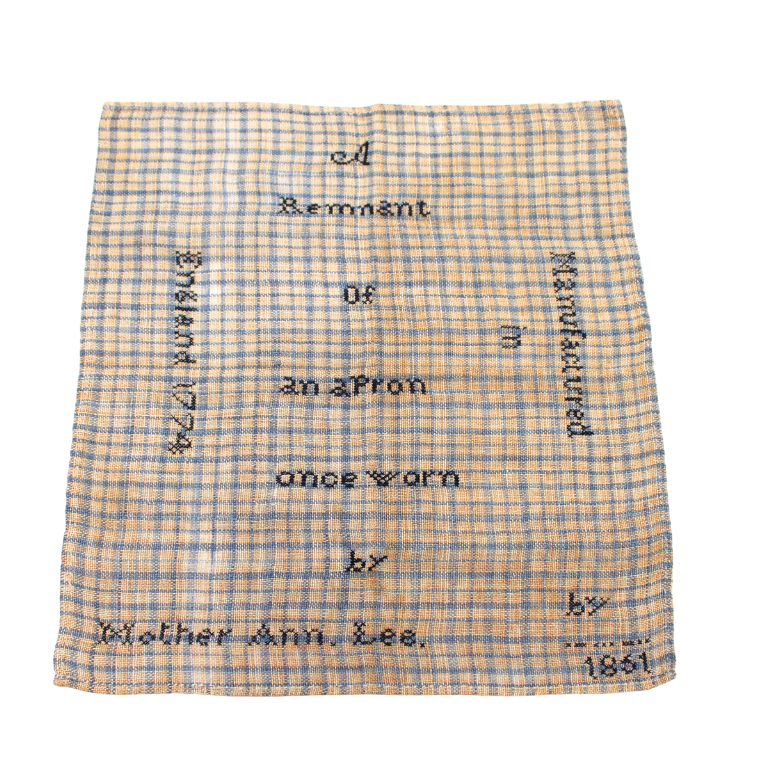
Mother Ann Lee’s blue-and-white checked apron fragment will be on display at the Village this summer. This textile piece was embroidered in 1861 by girls taught by the Shaker Sisters. The lesson here is multi-layered: this apron was believed to be worn by Shakerism’s spiritual and historic leader, an apron is worn for work, the work of sewing is a practice of the care of others in the community through the care of objects.
As the Village’s staff this spring prepares the site for opening day on May 16, we are thinking about how the Shakers may have thought about the season and its work. Spring cleaning once defined the work of farmers clearing fields to prepare for the year’s sowing. With the rising use of coal as an energy source by the 1840s, the term was used to describe the work of scrubbing away a winter’s worth of smoke from house interiors.
The Canterbury Shakers, however, went with what they had aplenty in the late 18th and 19th centuries: wood. And wood’s smoke residue required the dedicated time and dry warm weather to clean painted walls and floors and wash windows inside and out. The Holy Orders of 1841 prescribed that “Brethren shall build the houses, and paint the outsides of them. Sisters shall clean them up and do the painting and staining inside, and always paint all the window sash.” In addition, “Sisters shall clean brethren shops once a year.” Little wonder we find the Sisters’ recipes for paint, glue, and soap in the same handwritten books that contain recipes for food.
The Holy Orders also stipulated that Sisters undertake outside work as warm weather returned: “Brethren and sisters shall turn out in the spring and clean up the door yards, and highways.” Fences also were to be repaired in spring.
And then there’s the shift from cold weather wear. Released and aired from storage room closets, built-ins, drawers, and chests were clothing and bedding of linen, cotton, and worsted. Washed and folded and put away were heavy winter woolens and flannels.
Mending was part of spring cleaning but it was, in practice, a year-round habit of mind and hand. Waste was discouraged. Catharine Beecher, in her Treatise on Domestic Economy (1841) counseled that a bedsheet worn thin in the middle be “turned”—that is, torn down its middle and the outer edges sewn together—to extend its original usage. We haven’t textual documentation of such thrift among the Canterbury Sisters. But we do have the clothing and other textiles that show the remediation of wear: altered clothing, replacement buttons, repaired tears, and even fabric scraps kept in reserve. Well into the twentieth century, the Canterbury Sisters mended their clothes.
Tending to the duty of mending expensive textiles was not a chore but rather a practice of neat economy. It was a form of care for others’ comfort and presentation. Mending, as meditation, could also mend the self.
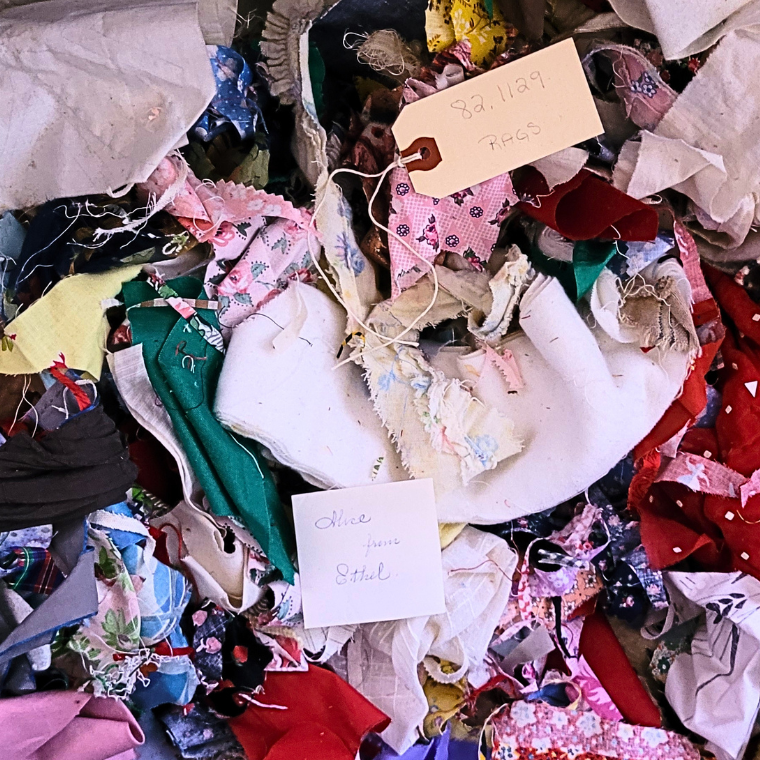
Scrap and fragment usually refer to a piece detached from a larger whole, but scrap more often describes something to be discarded. The Village’s current sitewide Collections inventory is a form of all-season cleaning, in which every object’s condition is inspected. This cache of 20th-century fabric and paper scraps—the results of cutting dress patterns—was a surprising discovery, especially because of the notes included in the assemblage. These fabric pieces were intended to be repurposed. As historical evidence, these scraps are fragments of the larger story of the Canterbury Shakers.
Communal living required system. So do museums! The Shakers’ use of numbered storage drawers, closets, rooms, and baskets was part of a larger system of order that reduced personal preferences and increased efficiency. So, too, are museum systems of collections storage, archival method, and object cataloging. Every thing in its place—even fragments, because what is so special about the Village’s collections are in the small things forgotten, the forlorn objects that, to many, seem to have had better days.
Perhaps we may update Mrs. Child’s insight: “The true economy of museum work is simply the art of gathering up all the fragments, so that nothing be lost.” Mended textiles, fabric scraps saved by one Sister for another, peg rails and gravestones removed by Brethren and repurposed, pails so well used they are reduced to staves and hoops awaiting an expert hand to become whole again: these objects, too, tell stories. Separated from the Village, these objects lose their evidentiary voice. As parts of the larger assemblage, these historic objects of frugality, sustainability, and shared belief help us understand the daily lives of those Shakers who left no other records but the work of their hands and their hearts.