




Turning Mill Farm to End in 2025. Q&A with Andrew Messenger
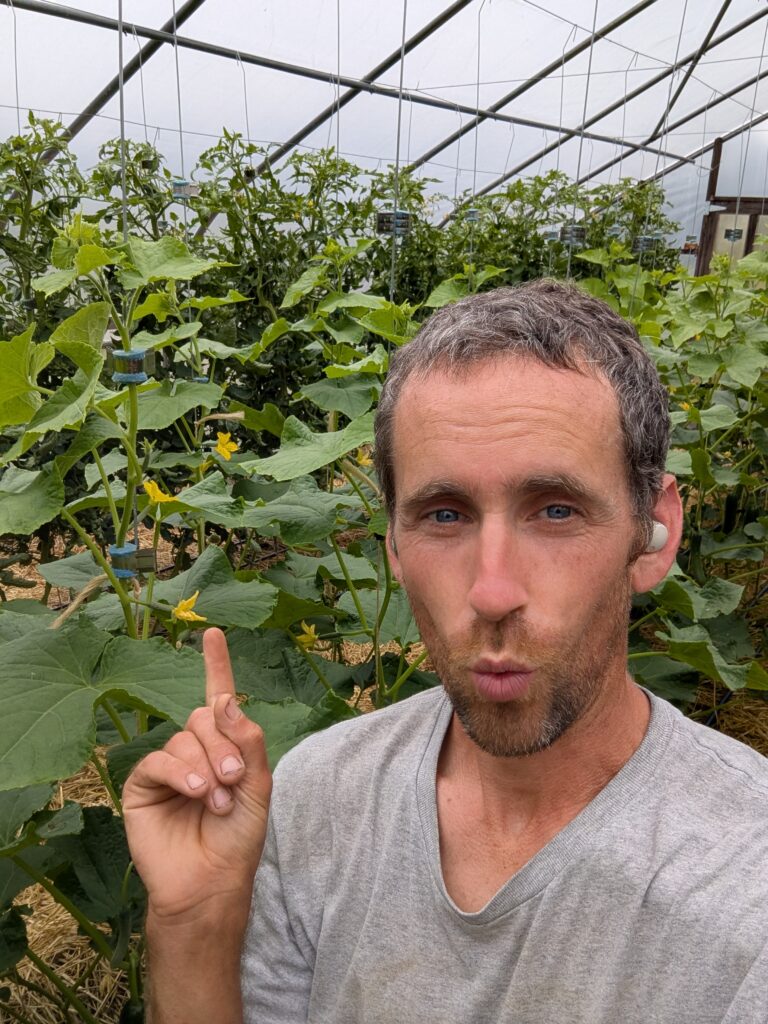
The men and women who founded Canterbury Shaker Village in 1792 saw this beautiful plot of land, then known as Whitcher Farm, as a place of opportunity to establish a community of faith rooted in the core principles of Shakerism. In 1795, they sectioned out a portion of the hill overlooking their mill pond as a vegetable garden to feed their growing village.
In 2022, Andrew Messenger also saw opportunity on this hallowed land.
At the time, the Concord Food Co-op had been growing vegetables at the Village, with Messenger working on the land as lead farmer, which he’d done since 2018. When the Co-op decided to discontinue the project, he incorporated the operation and established his own garden, Turning Mill Farm. It’s been rooted in the core principle of environmental sustainability via the practice of low-till farming, done primarily with Messenger’s own two hands. Fittingly, he’s been working the same garden area the Shakers first did over two centuries ago.
“You can see in the land the way that the beds used to be laid out,” said Messenger. “They used to be 90-degrees different to how they are running now.”
Over the past three years, Messenger has built an impressive operation that has stayed true to its founding principles. He’s sowed nearly every seed and harvested nearly every crop put into the soil here and has been very intentional about the tools he uses. He’s provided a community of customers with a safe, healthy, and local food source, selling at both the Canterbury Farmers Market and the Concord Farmers Market. Finally, Turning Mill Farm has enhanced the grounds of the Village with an active garden that ties back to its historical uses, with beautiful rows of kale, fennel, and various other vegetables matching the orderly Shaker aesthetic.
Unfortunately, Turning Mill Farm will cease operations at the end of 2025. Messenger and his wife have found a new opportunity, though, this time, out of state. The farmer, who has been working on vegetable gardens across the northeast for close to 15 years, is hopeful that his new ventures will be tied to agriculture as well, though no matter what, he’ll maintain a personal garden.
For Andrew Messenger, he’ll always look for an opportunity to put his hands to work growing food he loves.
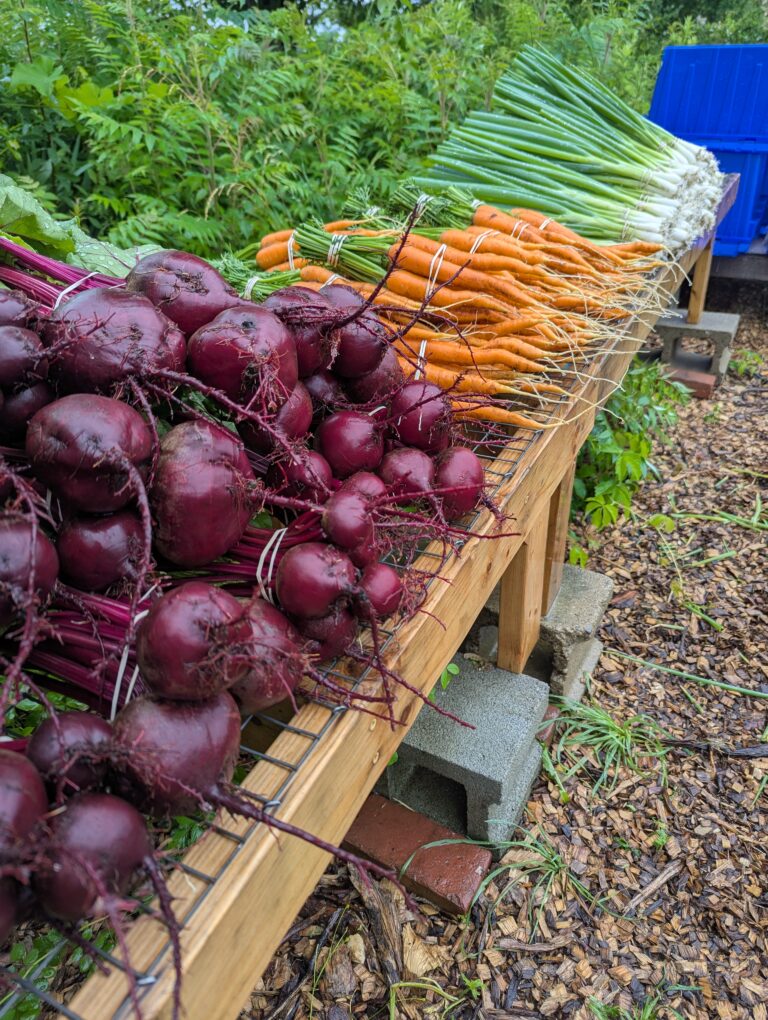
In November, Messenger was kind enough to sit down in conversation about his experience farming at the Village over these last eight years. This conversation has been edited for length and clarity.
You are sunsetting the farm and heading towards your next steps. What does it take to kind of put the farm to rest?
There are some obvious things of removing crop residue from this year. I have some plants I’ll move to the compost pile. If there is enough time in winter to remove vegetables, I can seed a cover crop, which is my preferred option to over-winter a bed. Depending on the timing, you can either plant something that dies over the winter, which is easier to incorporate in the spring, or you can seed something that does survive the winter, and those come back in the spring. I like to at least make sure there is no bare soil over the winter. So I’m mulching with whatever is available, I have a lot of straw mulch I get from a farmer in Kensington. You can use leaves, wood shavings. One of the last things is planting garlic. I planted one bed yesterday and trying to get the other done today.
I was reading the NOFA-NH interview and you were talking about your inspiration for getting into farming after art school. I’m paraphrasing, but the sentiment was that you wanted to do something practical and tangible and spend time outdoors doing some sweat equity. You saw farming as a way to make a positive impact and incorporate these characteristics you wanted in a job.
Now that you’ve been farming for a number of years, how has your lived experience matured and evolved from the sentiments you expressed about what you hoped to get from this line of work?
I think some of the initial experience was more environmentally focused, and I wanted to make sure I had more than just a job where I clock-in and clock-out and go home; I wanted more of a livelihood for myself. That still applies, but in being a market gardener these past three years I’ve found the most meaningful things I’ve been getting out of the farm has been my interactions with my customers. Coming back every week, chatting with them. It’s still working, but the thing that keeps me going is knowing that I’m meeting people who want to eat my food and value it and cherish it. I feel like I am a member of the community and people appreciate what I do.
It’s one thing to have a nice pretty garden, and it’s another to have your food in someone’s fridge and feeding their kids with it. It added an extra layer I didn’t know I was exactly looking for.
When I was working for the Co-Op most recently, that was just five years of growing it and leaving it at the store, and whatever happens to it, happens to it. Before that, I worked on a CSA farm, and that was all production, and the produce would go on a box truck and go to pick-up locations. It felt really satisfying loading up pickups full of food, but I didn’t interface with the end users.
You’ve been here for a total of eight years, and running Turning Mill farm the last three years. You mentioned in that same article that each year you refine the operation, and the farm ecosystem improves. Could you summarize the ways in which you’ve seen this farm ecosystem evolve and the areas you’ve refined things?
I do everything on a hand scale; I use hand tools. The first tool I use to prepare a bed is a broadfork, its a long tined fork that is aerating the soil. I started eight years ago putting that thing in the soil and there was a lot of resistance when you’d pull back on the handles. Over the course of doing that to the same beds, twice a year, for eight years, the soil is looser and pliable and easier to work. The color has improved a little bit; it’s gotten darker and richer and more chocolatey brown. Those immediately come to mind.
There are certain pests and weeds that pop up that are specific to the way I grow compared to when I first started. I do a lot of mulching, so the soil really appreciates that, and so do slugs (laughs). There are certain crops that resist that better than others, so if I were to proceed doing things in that system, I’d focus on things that don’t get completely devoured by slugs. Also, the fact [the garden] is minimal till, the weeds are drifting more to perennial weeds or encroaching more from the edges.
You wanted to keep capacity low and basically do what you can complete with your hands; those are some of your guiding principles. When you know the tool set will be limited to hand-level, what areas in production and harvesting do you go to innovate and keep things evolving?
This winter I put some thought into the two or three things that I felt like I could address and save time on. One of the things was spinning salad greens. Half my sales are bagged lettuce mix and there is a huge demand for it. I was using just a 5-gallon hand spinner. You have to do that 20 times per batch of lettuce and its pretty tedious. It was an investment, but I got a 20-gallon electric spinner that saved me a lot of time.
An interesting way of evaluating things is everything requires work. Work from me burns calories, work from an electric appliance is burning electricity, work from a tractor is burning fossil fuels. The work is being done by something, but I feel better when the work is either done by me because it feels sustainable in some way, or if it is done by something biological, like a cover crop is smothering weeds for me so I don’t have to till it, or it’s aerating the soil because the roots are going down deep.
Sometimes it’s a matter of just buying a new tool, but I could spend $100,000 buying tools (laughs), so I’m limiting myself to two or three a year. This year was the salad spinner, and a tool that I thought would help hill carrots. I didn’t end up using it (laughs), but the idea was good.
I’ve noticed that once I find something to be a bit annoying to do, then I’m less likely to do it. Just recognizing the fact that I don’t want to do something means that system is not designed in a way that it is efficient enough for me to want to do it.
Trellising tomatoes and cucumbers in a greenhouse takes a lot of work, but it keeps the fruit off the ground and the plants don’t get wet and have fewer diseases and generally you have a higher-quality crop. But there is a lot of extra labor associated with that.
I switched over to a different system and was going to save some time according to other farmers I talked to. Initially it worked very well, but I don’t know if my grafted tomatoes’ stems were too thick or I was using a different sized clip, but it was getting to the point where I couldn’t even get the clip off the plant because the stem had swollen so much you couldn’t get the clip off. I thought I was saving time, but now it’s become so annoying I didn’t actually do it at all. I gave up on the tomatoes in August and they just started growing wild.
I don’t enjoy feeling like things are out of control, but farming, at least during the summer, you always have more things to do than you have time for and it’s kind of like an act of triage every day. What is the absolute most important thing that needs to happen and work down from there. It’s a daily exercise in decision-making and prioritization. Sometimes your decisions are forced by other factors, like, I have a Saturday market and I need to be harvesting for that on Thursday and Friday. Then, if Friday is going to be raining, then I guess I’m harvesting my greens on Thursday so I can spin them and keep them dry. You don’t always get to pick the most important thing to do (chuckles).
You’ve been working this plot of land in different roles for eight years. What have you learned over time about this literal space at Canterbury and how the environment and ecosystem work together ? Also, what have you learned about yourself as a farmer in that time?
The place is interesting. I’ve learned more about how much of a community space it is, in terms of number of people who walk by and how much of an impact the garden has walking through. The better the garden looks, the better people respond to it, so it’s a positive feedback loop. The better it’s looking, the more people compliment me on the gardens. I’m a bit of an introvert and get tunnel vision at work, I like to just be working. It was a little bit of a challenge for me working in a fishbowl. I didn’t know when I needed to have my “interacting with people face” versus I can just put my head down and get stuff done, especially when you have 19 things to do.
I think I’ve learned that I really enjoy feeling in control and on top of stuff. This scale started to get a little bigger than I could handle and that got stressful.
Work-life balance is another thing that directly ties to the size of the garden. The bigger the garden is, the more I’m working in the garden, the more I’m getting burned out. Last year I was burned out in May and June. This year I didn’t burn out until July (laughs), so it went alright. Burnout will always be a thing when you are working in the elements, working long days. But being more mindful of that and feeling okay not getting everything done, or taking a little time off and prioritizing myself over my to-do list.
You are operating in space that traditionally had been a vegetable garden for the Shakers. With your sense of how you wanted to operate your farm, was there anything you looked back into how the Shakers were doing things here or what types of innovations or methods they had that could be replicated again? Was there history that was useful? Or was that 150 year ago, and you have to get your farming done in today’s world?
I’ve seen pictures of them using a very early tractor and then before that oxen, so there was more traction in the field, whether steam-powered or animal-powered (chuckles). From the get-go, I’m a little bit different in how I do things.
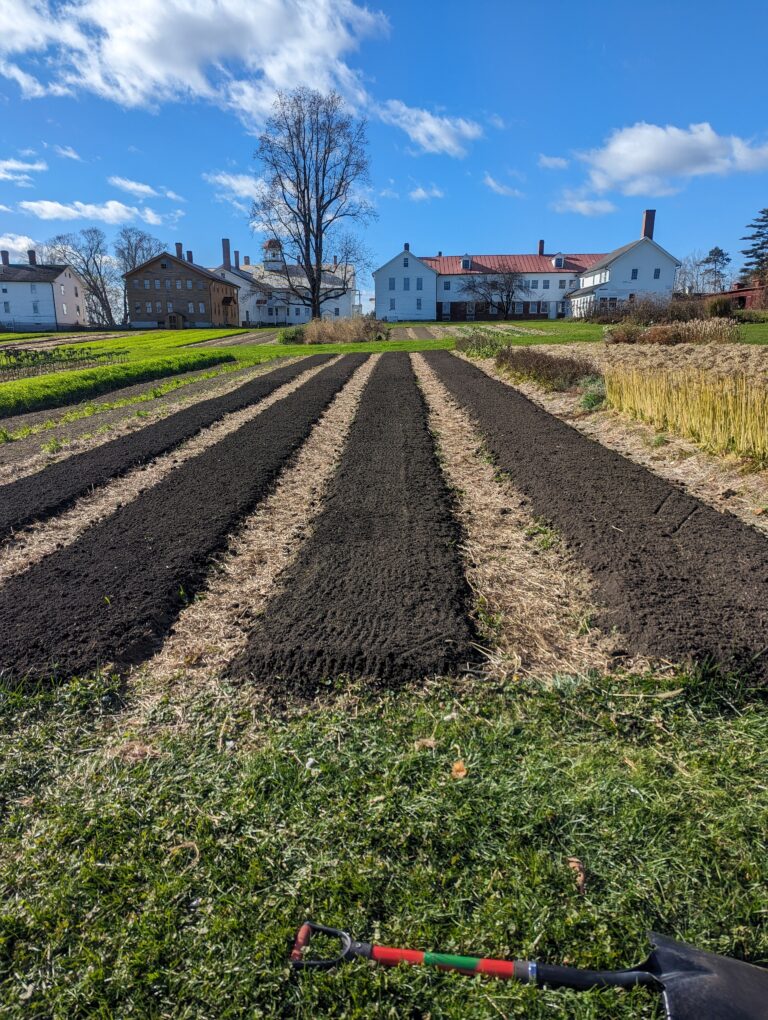
I’m not doing it entirely consciously, but I think the main thing is the Shaker aesthetic gets reflected in the garden. The tidiness, the orderliness, the straight rows. It’s not totally connected, but you can see in the land the way that the beds used to be laid out. They used to be 90-degrees different to how they are running now, so long ways. You’ll see these little dips where the beds are running; they are not totally leveled. It’s interesting to observe and you can notice in the downhill corner that it is all grass now. When you are driving over it with a tractor, you’ll hit all these bumps, and you can tell at one point that it was plowed up and there were beds there.
For people who know you and know the Turning Mill Farm and the history of the Village, is there anything you’d want them specifically to recognize about the way in which you farm and how it’s been done here?
My first year starting out on my own after the Co-Op laid me off was a little bit freaky. Running the business and trying to figure out where my markets where and how much I could sell to various markets. For me, marketing didn’t come super naturally, and not having good access to retail markets at first. I was doing Canterbury Farmer’s Market from that first year, but that market itself is too small to support a business on its own. I applied to the Concord Farmer’s Market that winter and luckily got in. The difference between year 1 and year 2 was that sales doubled. I don’t know what the message is there exactly, but making sure you have a market for the stuff you are producing is super important.
But also, Canterbury has the potential to be an exemplary community market with great energy and spirit. I was pleased to see my sales growing year by year. However, the customer turnout from week to week was inconsistent. On a good week, 200+ people would show up and support you. On a bad week, I would come home with my car still mostly full of vegetables. The extra produce gets donated but preparing for market and vending for two and a half hours is a lot of work to come home with quantities of unsold goods.
This helped to reinforce for me that if you want small farmers in your community, you need to reliably show up and support them. I’m trying to internalize this for myself as well. Before I was a vendor at the market, I was not a particularly reliable customer, and I will strive to be a better supporter of small, local farms and farmers going forward.
What would you say is your crowning achievement of Turning Mill that you feel is most resonant with what you set out to do?
I’m pretty happy with the reputation I gained with my customers and with my wholesale people. I think people recognize my produce as being really high quality and affordable and those were two things I prioritized. People responded to that. It feels like I built a business with a good reputation and people were happy to have me back at the market.

About Canterbury Shaker Village
Canterbury Shaker Village is a nonprofit-owned National Historic Landmark district featuring 25 restored Shaker buildings in their historic setting of 694 acres of forests, fields, gardens, and mill ponds. In addition to museum tours, exhibits, and programs, the preserved Shaker village provides a beautiful, relaxing, and inspiring environment for recreation, learning, reflection, and renewal of the human spirit.
Canterbury Shaker Village is a member of the NH Heritage Museum Trail, which connects the public with culturally rich heritage institutions in New Hampshire. For more information about The Trail, visit nhmuseumtrail.org.